
Place
10/12/2024
Boulder, granite, winter: welcome to Cresciano!
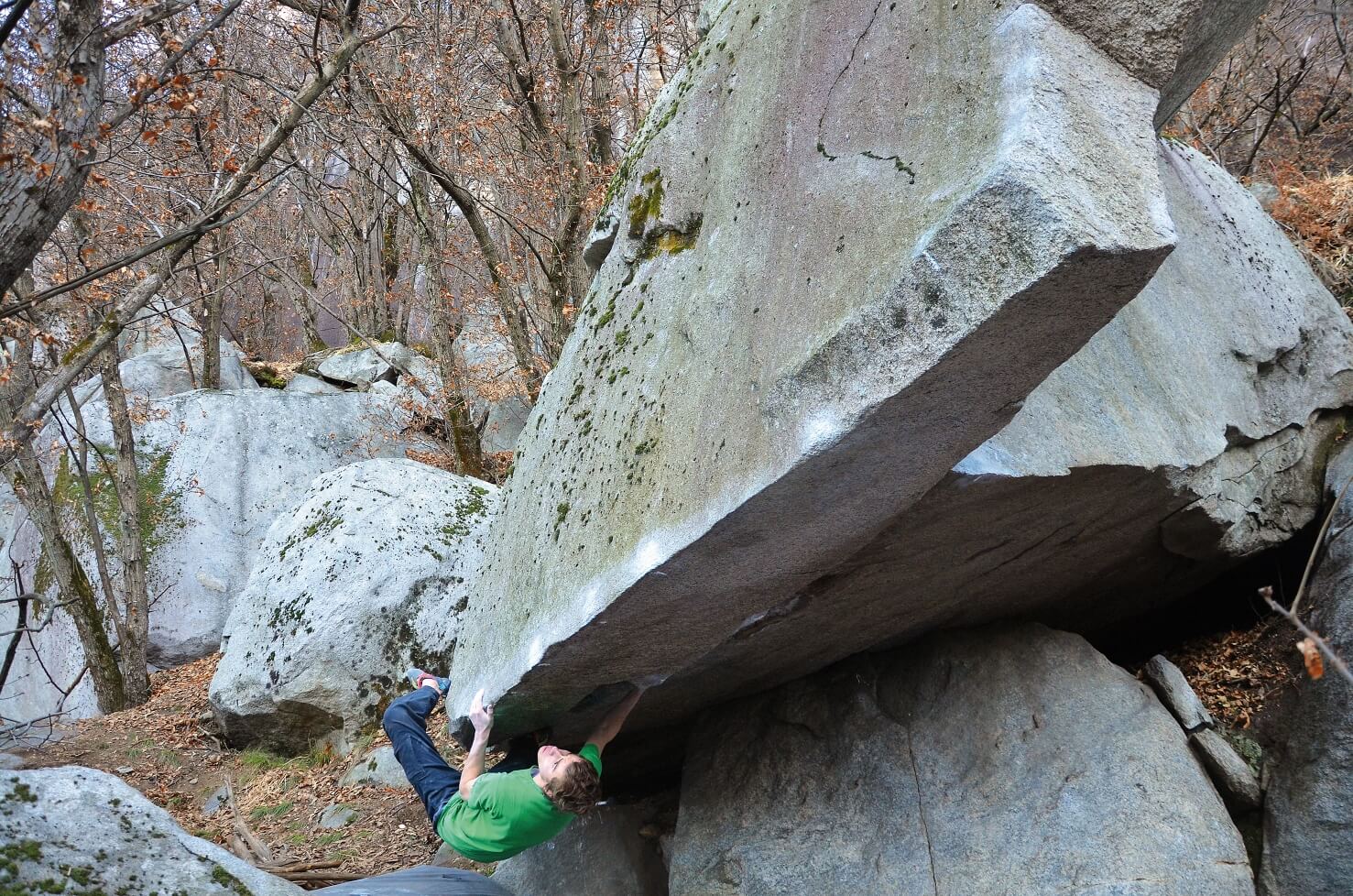
Giuliano Cameroni on Iur, 8b+, Nuova Tribuna Centrale. Credits to Samuel Ometz
Ticino is one of the richest areas for bouldering in winter, and we are not just talking about a paradise for Swiss boulderers: thanks to its strategic position, Ticino is often the destination of the best weekends on the rock for Italian and German boulderers.
Of all the numerous areas that today make up the reality of "Ticino Bouldering", and which are well described in the four guidebooks that have been published over the years, Cresciano undoubtedly represents the most historic.
First discovered and appreciated by Fred Nicole and his companions, then by various local climbers such as Claudio Cameroni, Roberto Grizzi and Renzo Lodi, who also undertook the immense work of collecting photos and information for the guidebook, Cresciano area now includes 28 sectors and is presented in the fifth edition of the guidebook, which you can find at this link.
The development of Dreamtime, a pioneer compared to the latest generation of areas, dates back to the late 1990s, but its potential exploded in the eyes of the international public and top climbers with the first ascent of Dreamtime by Fred Nicole in 2000.

Marco Muller solid on Dreamtime, 8b+/8c, photo by Benjamin Weber
boDreamtime, the symbol of high difficulty
Dreamtime definitively marked an epoch in the world of bouldering: at the time considered the first 8C boulder in the world, it became emblematic of high difficulty also due to the beauty of its movements and its ten-metre development, not so easy to find. Its line, which is practically perfect, has a sit-starts on the right of the boulder and continues with delicate movements on bad holds, then to a decisive dyno to the edge and a traverse towards the left edge. In total they are 21 highly demanding technical, power and coordination movements.
The history of Dreamtime has since seen some readjustments in difficulty, holds breaking and subsequent re-evaluations, but it has always remained indelible in the collective imagination of ‘extreme’ bouldering, despite the increasing level of many boulderers. Its openness also exerted a strong appeal on American climbers such as Dave Graham, Jimmy Webb and Paul Robinson who, thanks to films such as Better Than Chocolate and other videos on Swiss bouldering, contributed to increasing the hype towards these areas.
The news of Michaela Kiersch's first FFA is also very recent, adding a milestone in the evolution of women's bouldering. Other strong female boulderers had besieged Dreamtime before her, seeking alternative solutions to the most difficult cruxes, such as heelhooks, intermediate holds and various strategies. Michaela Kiersch succeeded in realising a dream of so many female climbers and climbers, climbing - with absolute determination - a line that is still ‘history’ today.

Diego Cameroni heehooking on Scacco Matto, 8b, Brasc Vunc sector. Photo by Claudio Cameroni
Cresciano over the decades
More than twenty years have passed since the publication of the first guidebook on Cresciano, which in the meantime has consolidated itself as a reference destination for winter bouldering, without ever going out of fashion. The extremely high quality of its granite, abrasive to the right point to guarantee a good grip but without immediately wearing out your skin, the beauty of the landscape and its incredible exposure to the sun are some of the factors that have continued to draw so many climbers to these perfect boulders year after year.
Despite its fame being linked, as is often the case, to the appeal of the more difficult passages (other great classics are La Boule, 8a, La Pelle, 8a), Cresciano is an area capable of entertaining boulderers of the most diverse levels of difficulty and experience. Its landings, which are often flat, the minimal approach to reach the first boulders and the proximity between sectors (the most remote being Dreamtime) also make it pleasant from a logistical point of view.
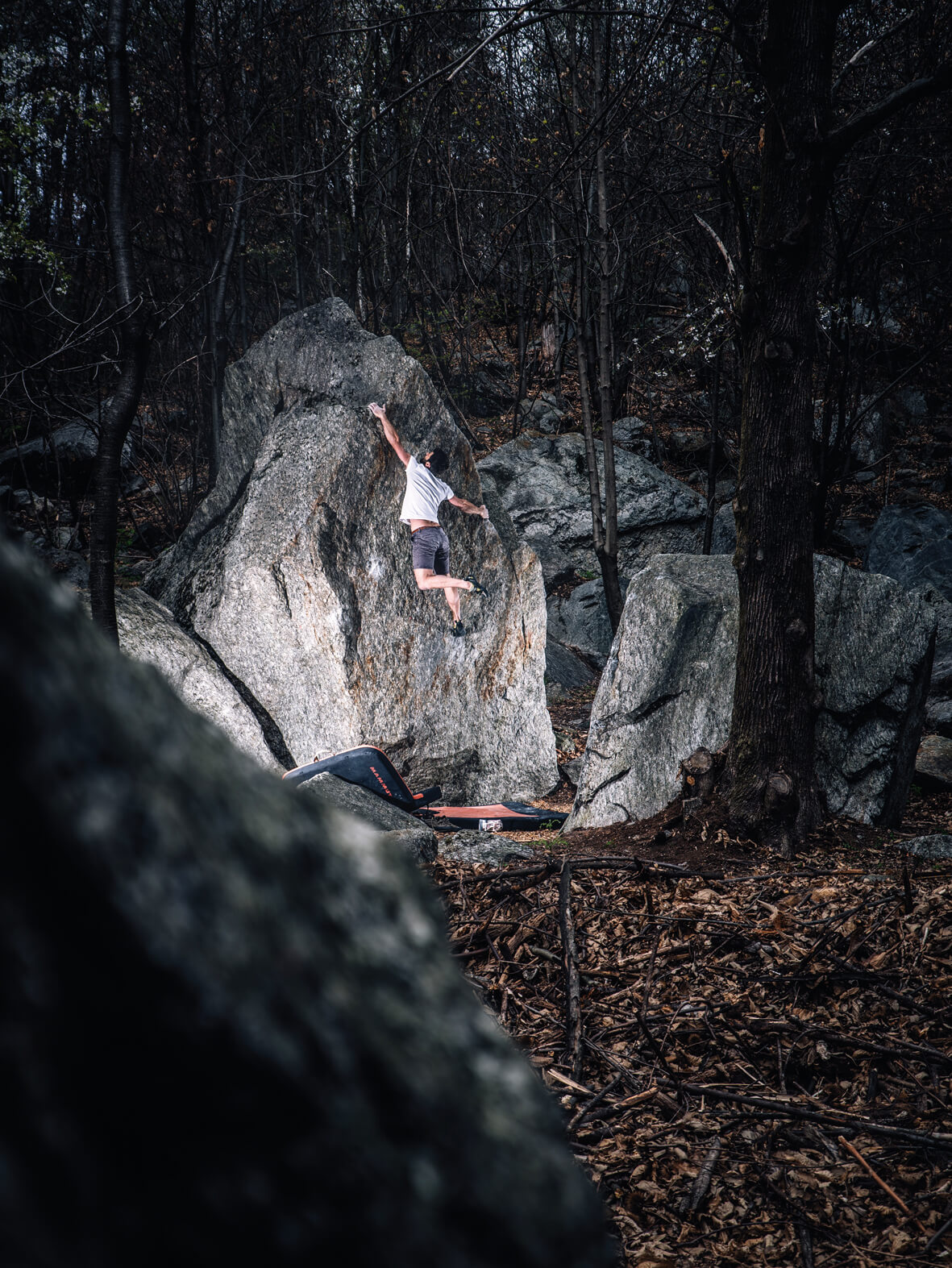
Bouke Grijseels on Catena di Luce, 6b, Biasca sector. Photo by Lukino Ramelli
Cresciano: where, when and how
The opening of the Cresciano Hostel, initially run by local mountaineers and later reopened under different names and new management, gave everyone the opportunity to sleep warmly in the middle of winter, with maximum comfort and at affordable prices. The recent reopening has brought a new wave of visitors to the boulder area, who can once again enjoy top services and unparalleled comfort, considering the cold weather of the winter months. You can find all the relevant info on the official Hostel Cresciano website.
Although it is generally considered a winter destination, if you are planning to visit Cresciano during the Christmas holidays, you must take into account the possibility of finding cold conditions and perhaps even a few snowflakes to make the landscape even more magical. On the other hand, the nature of the rock requires particularly cold temperatures in order to obtain the best grip. It is always a good idea to find out about the general conditions in the area before planning a trip to the heart of Ticino.
The style of climbing in this area is both technical, especially on the slabs, which are not very easy to hold on to, and physical, as in the pronounced overhangs that characterise the most demanding passages. Good finger strength is always a good ace up your sleeve, as there are no shortage of passages on crimps, and some of the "granite grains" typical of granite can prove decisive if they are properly full-crimped!

Giuliano Cameroni on Great Escape, 8b, Nuova Tribuna Centrale sector. Photo by Francesco Campana
Three unmissable sectors
https://www.oliunid.com/ticino-boulder-cresciano-boulder-2023-bouldering-climbing-guide.html presents some new sectors that deserve to be discovered by the most faithful boulderers: Preonzo, Posito, Lodrino, Biasca and Malvaglia are some of these surprises that make the work of the authors (Claudio Cameroni, Roberto Grizzi and Renzo Lodi) even richer and more interesting.
At the same time, the more historical and classical sectors of the area do not lose their charm, such as Filo a Sbalzo, one of the first to be found when you come out of the car park, La Boule, Nuova Tribuna Centrale and Brasc Vunc.
Filo a Sbalzo is, unsurprisingly, one of those sectors that are very suitable both for intermediate climbers, who can find more than a hundred passages of up to 7a, and for experienced or high level climbers looking for very high quality passages to warm up. For this reason, as well as its proximity to the car park, it is one of the most frequented sectors of the Cresciano, able to combine all the climbing styles found in the other sectors. The mostly flat landings and the height of the boulders, which is almost never excessive, allow everyone to get used to climbing on the granite of Cresciano, going step by step.
The sectors are all very close to each other, so it is natural to move from Filo a Sbalzo to Artisti Tristi or from Naso di Zmutt to Nuova Tribuna Centrale. The latter is also a sector particularly recommended for climbers looking for passages up to 7a, although the rock faces hide some gems reserved for the most difficult climbers. Here, however, the heights become much more demanding and the falls often require protection, so some previous experience in rock climbing may be useful.
The La Boule sector, a historic 8a line, is also easily accessible from the first sectors: the homonymous boulder is often attempted by climbers who want to try a classic 8a passage. The beauty of the line, the solidity of the rock and the landscape in which it is immersed make this boulder, and the whole sector, always a pleasant destination for climbers of all levels.
Among the new areas presented in the guide, those of Malvaglia, Prosito and Basca are among the most interesting. Biasca is particularly suitable for families and beginners, with generally easier lines, pleasant approaches and excellent landings.
For more information and details, see the new edition of the Ticino bouldering guide Cresciano.
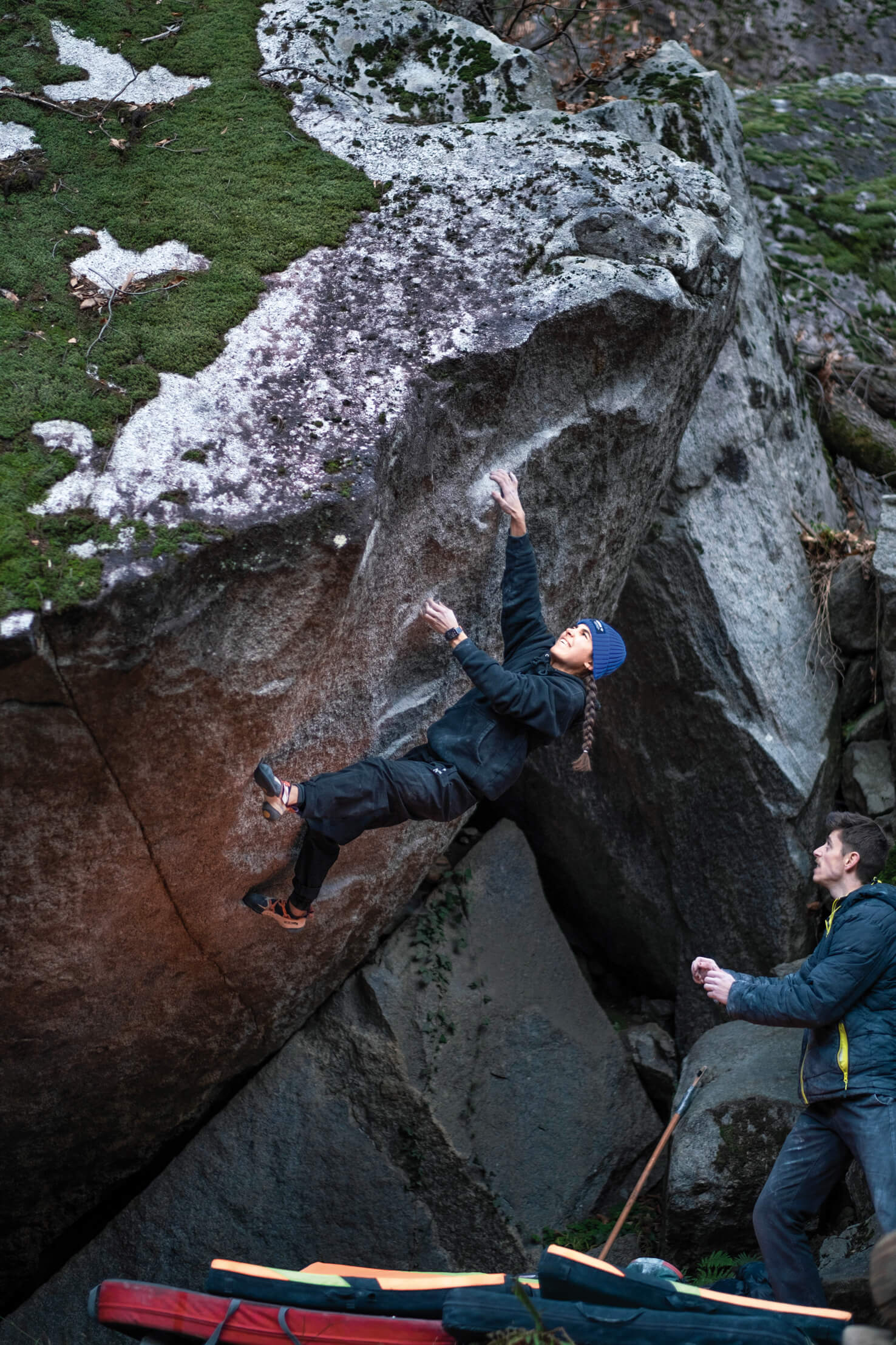
Brooke Raboutou on La Proue, 8b, La boule sector. Photo by Finn Stack


