
A trekking backpack is an essential tool for any outdoor activity. It can be small and compact for quick trips lasting a few hours or spacious and structured with many compartments for treks lasting several days. However, choosing a trekking backpack is much more complex than simply considering the number of liters and volume: from the materials to the ergonomics, from the type of closure to the materials used, there are many factors to consider when choosing a backpack.

Ali Schroeder and Kendra Hicks hiking up towards Mount John Clarke in British Columbia (Canada) with Patagonia Ascensionist 55 backpack. Photo by © Jessica Braidwood, Patagonia
Capacity
However, let us start with one of the most obvious and easiest factors to use as a parameter of choice: in this case, we will not only evaluate the duration of our excursions and their seasonality to understand how much material we will have to carry, but we will also make a choice proportionate to the build of the person who will have to carry it on his or her shoulders.
Small backpacks 4-20 L
Backpacks ranging from 4 to 20 liters are particularly compact and lightweight, and they also fit the needs of mountain running, trail running, and more aerobic daytime activities. They are generally very close-fitting to the body so that you have absolute freedom of movement and are sufficient to hold water and food for a day and a change of clothing. They are suitable for light hiking and trail running for a few hours, but not infrequently have such attractive aesthetic lines that they can be used as “city life” backpacks and accompany you in your everyday life. Understated and essential, they have minimal lines that support you in carrying the bare essentials.
Medium size backpacks - 20-40 L
Backpacks between 20 and 40 litres are a good compromise between lightness and capacity and will meet most of your needs for a few days in the mountains. These are backpacks that are already large enough to carry more technical equipment such as trekking poles, and the more multi-purpose models, which are also suitable for winter activities, may have slots for attaching skis or ice axes. Backpacks between 20 and 40 litres can be divided into very different models depending on the season in which we use them and therefore the activity involved. They are still not suitable for carrying everything you need for a multi-day trek without logistical support, but with a little savoir faire you will be able to organise a decent amount of equipment. With backpacks of this capacity, the presence or absence of a backrest - usually an internal one - which structures the fit and helps you distribute the load without putting too much strain on the lumbar region of your back, also starts to become relevant.
Big backpacks - more than 40 L
The models with a capacity of over 40 litres give you the most options as you start to take on significant volume. Considering that the more volume you have, the more weight you have to carry, these backpacks have been designed with excellent ergonomics and the best solutions for carrying as much gear as possible without straining your back. Their backrests, which can be made of plastic, aluminium or carbon, help to distribute the weight of your pack so that you can enjoy hiking with a considerable load on your shoulders. The function of the backrest can be supported by the waist belt, which we recommend be as thick as possible, and by the adjustment buckles on the shoulder straps. They are suitable for multi-day treks, possibly with overnight bivouacs: in this case, we advise you to choose backpacks that also offer maximum comfort for carrying a one-person tent and sleeping bag.
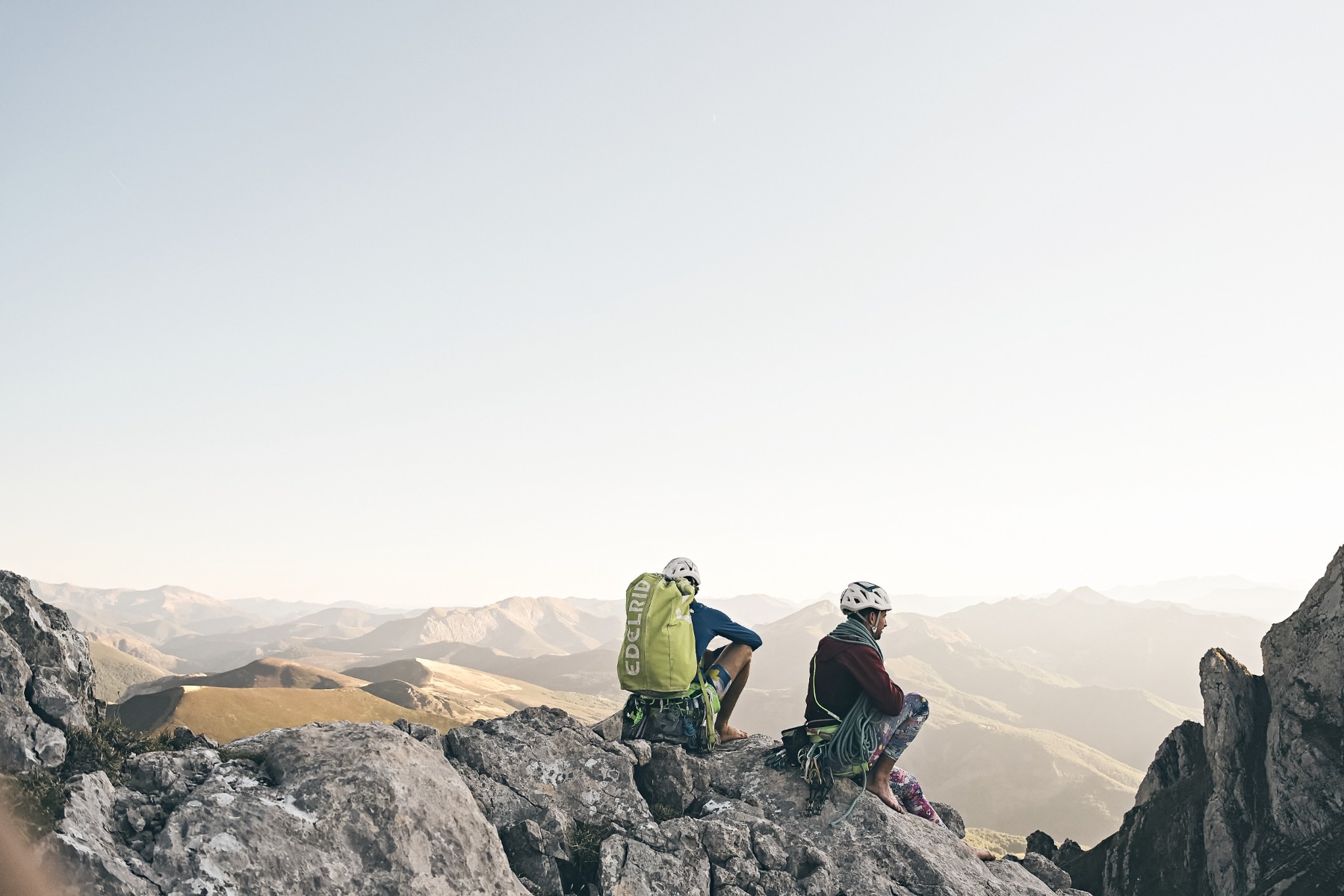
Backpacking in Picos de Europa with Edelrid backpacks. Photo by Christoph Muster, Edelrid
But how much should a backpack weigh?
Depending on the season and the amount of clothing and technical equipment we carry with us, a rucksack of a given capacity can hold a different amount of material in its weight. The general guidelines are not so much to tell you how much a 15 litre rucksack should weigh, but what the most appropriate load would be depending on your weight.
Generally speaking, the "ideal load" is 10-20% of our body weight: this percentage should then be adapted to our training, the type of activity we want to carry out, and its duration. Optimising the load in your rucksack is an important skill that can only be acquired through experience in the field.
Depth
The capacity parameter intersects with the depth parameter, which allows you to find your compromise between external and internal volumes. It is a value that is especially taken into account when we decide whether we want to use it as carry-on luggage, to have it with us even on our excursions around the world without having to check it in.
Opening
Frontal
The opening on the front of the backpack is the most convenient when it comes to backpacks with a very large capacity, as it allows us to have direct access to the material without having to empty it each time. However, this type of opening means that we can rest the backpack on the ground, and therefore it is not suitable in uncomfortable situations or on rough terrain.
Rear
In contrast to the front opening, it is particularly convenient if we want to access the material while temporarily keeping the backpack on one shoulder, and it is indispensable in backpacks with a large capacity for the same reasons of practicality as the front opening. This type of closure is most used for “vertical” activities, where we do not have the convenience of a surface to lay the backpack on, such as multi-pitch routes and alpine climbing.
Side
The side opening is usually a “plus” that goes with a standard opening such as the top one so as to have quick access to usually awkward areas of the backpack. Having more openings corresponds to a very high capacity, and having more openings improves its ease of use and access to material.
Top
It is the classic top opening that characterizes most backpacks and is practical in small or medium-capacity models.

Some of the well-appreciated Deuter backpacks that you can find in our Oliunìd Shops
Closure system
Buckle lid closure
It is the closure that is naturally associated with access to the material from above: it is very practical and widely used also because, unlike zippers, it is now very easy to replace buckles that wear out over time. One closure system obviously does not exclude the other, so it is possible to have in the same model the coexistence of buckles, zippers and roll tops: depending on whether we need quick access (better the zipper) or a system in which there is no risk of jamming (better the buckles) we will decide which one is right for us.
Removable lid
It is extremely quick to open and close, and very often, as in the case of ski mountaineering backpacks, it is arranged to be used even with gloves on. Sometimes it represents only a secondary closure system reserved, for example, for top or side pockets, but many backpacks with side or front opening rely totally on the exceptional durability of the latest zippers on the market.
Roll Top
The top of the backpack, which looks like a sack, rolls up on itself in a way that maximizes volume but also provides maximum waterproofing in combination with a water-repellent material. It is often combined with a front zipper closure and is easily found on backpacks also recommended for mountaineering and demanding mountain activities.
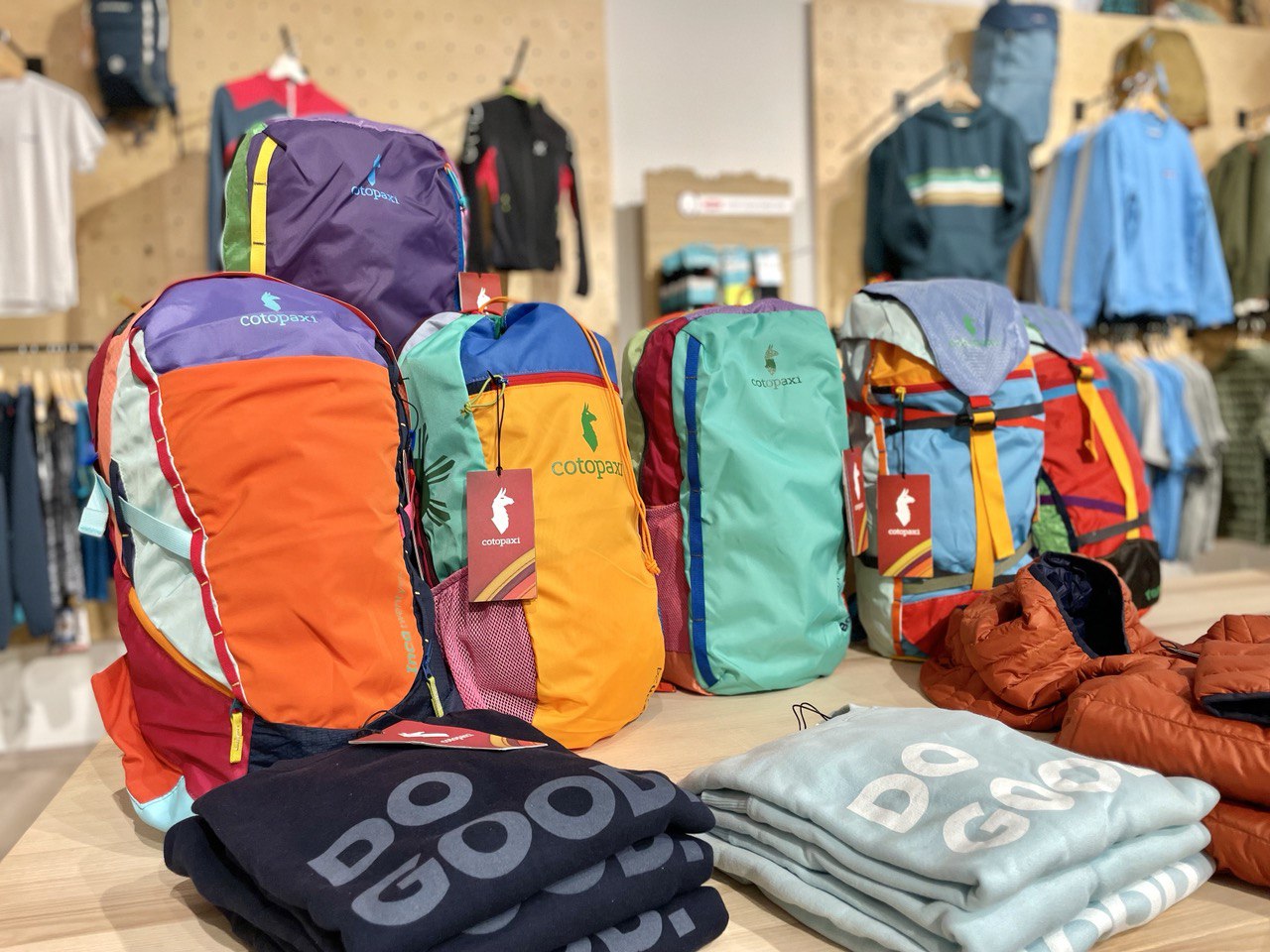
Cotopaxi backpacks for hiking, and city-life
More options
Typical of backpacks recommended for various mountaineering activities, it allows you to modulate volumes according to your needs.
Sospended back-panel
Indispensable on hot days or multi-hour hikes: provides excellent breathability and ventilation on the back, even with the most intense hiking.
Backpack raincover
It protects from abrasions and unintentional snags between rocks, shelters from water, and wraps all the buckles in case you have to board it on an airplane and makes the life of your backpack much longer!
Removable Hip Belt
You find it in many hiking, climbing and mountaineering backpacks and it goes very well with models where you can vary the capacity of the total liters. It is also very convenient for air travel: you will almost always be asked to remove the strap upon boarding to avoid various snags.
Poles fixation
You find them in the more technical backpacks that you use for different types of activities in the same day, such as mountaineering or hiking plus climbing. If you are a lover of walking with poles, this option can definitely come in handy.
Ice axe fixation
This is a typical accessory for mountaineering backpacks, not to be underestimated in case you plan to do mixed-use hiking. Slots may be present on medium or large backpacks, while they are often omitted on more minimalist models.
Hydratation system compartment
This is a pocket in which you can put water bags so you don't have to stop every time you want to drink to retrieve your water bottle. It is widely used in trail running and in situations where you want to go fast and hydrate very often.
Cover image: Riccardo De Conti, SCARPA


