
Trekking shoes are an essential part of our mountain equipment, providing us with comfort and stability; the aspects to consider when buying a new pair of shoes are many and depend on the type of activity we are planning.
Given the different environments - and the relative seasonality - in which we may decide to tackle more or less demanding hiking, it is difficult to think of just one pair of light and breathable boots in summer and warm and waterproof in winter. In this article, we will look specifically at the characteristics of winter footwear.
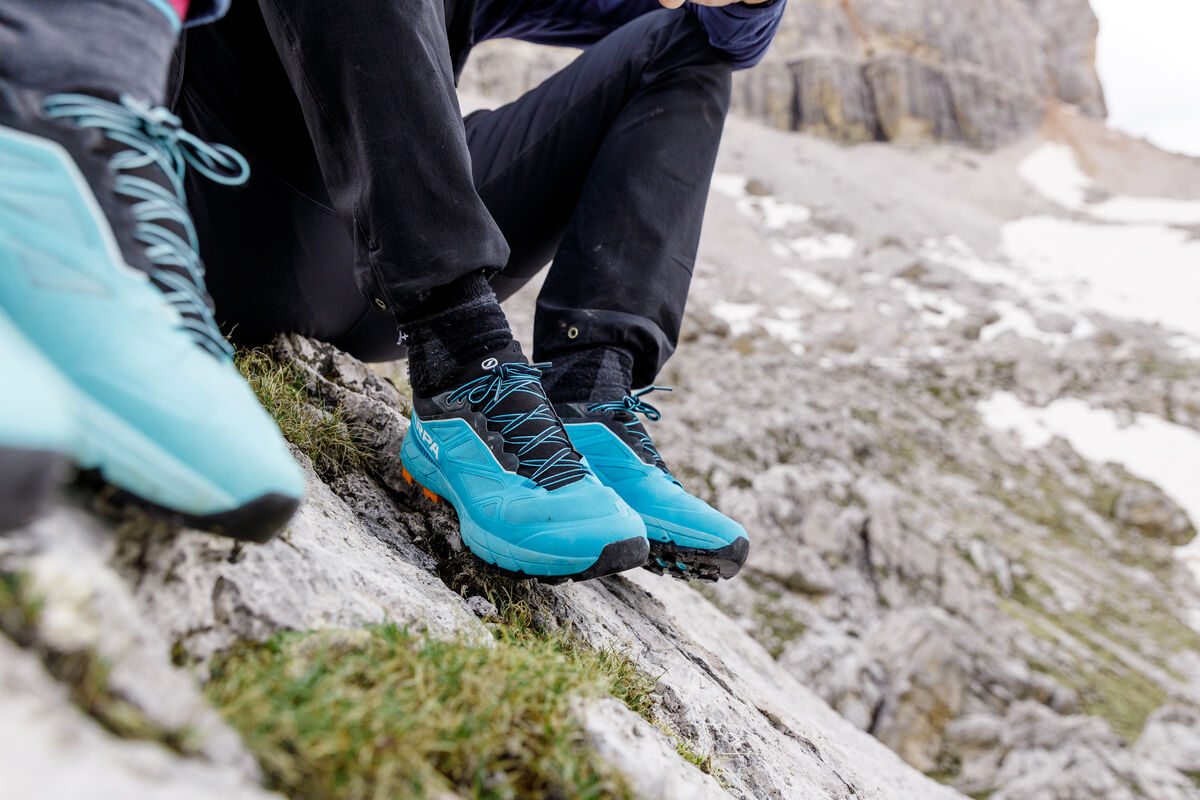
At Col de Bos with SCARPA Rapid, photo by Andrea Pavan
Low or high cut trekking shoes?
Usually, the first very simple and intuitive skim is the height of the trekking shoes. In fact, we can choose between low models, which also cross over, for example, with the approach shoes typical of climbers, or between models that reach the ankle, also called ‘mid cut’, or high cut models, which protect the entire ankle area.
Low-cut trekking shoes: for regular terrain and short hikes
Low shoes are suitable for hikes that are not demanding in terms of weather and terrain. They have the advantage of being particularly comfortable, flexible, and light, a real pleasure to wear in everyday life. Their function is to ensure a pleasant and safe hike, able to absorb any impact in lightly uneven terrains. Low trekking models often intersect with approach shoes; the possibility of having a very precise lacing at the toe and the presence or absence of a front climbing zone (see the section on materials) make the fit stable and wrapping.
Mid-height cut trekking shoes: ankle protection and support
Mid-height shoes have an instep height that reaches the malleolus and represent - in many respects - a middle way between somewhat more classic low shoes and high mountaineering boots. Mid-shoes have a medium stiffness, especially at the sole level, and are more structured than most low trekking shoes. The function of a mid-height model is to protect the ankle from twisting, ensuring stability, and absorbing stresses caused by partly unstable terrain. We can also recommend mid-height trekking shoes for short hikes with a heavy load on the shoulders, which implies more support at the sole level and a reinforced structure at the ankle level. Depending on how well the sole is engraved, you can have a more durable and structured model or a slightly lighter and softer one.
High-cut trekking shoes: for challenging terrains
High-cut trekking shoes completely envelop the ankle to ensure maximum stability even off-piste, and on all those very demanding hikes where protection and stability are required. These trekking shoes are undoubtedly heavier than other models, but they are also sturdier and more durable, with very strong soles that you can rely on even on slippery terrain. This type of boot also protects us from lateral torsion, always wrapping around the ankle;it is essential when carrying heavy loads on your shoulders or on the worst uneven terrain.
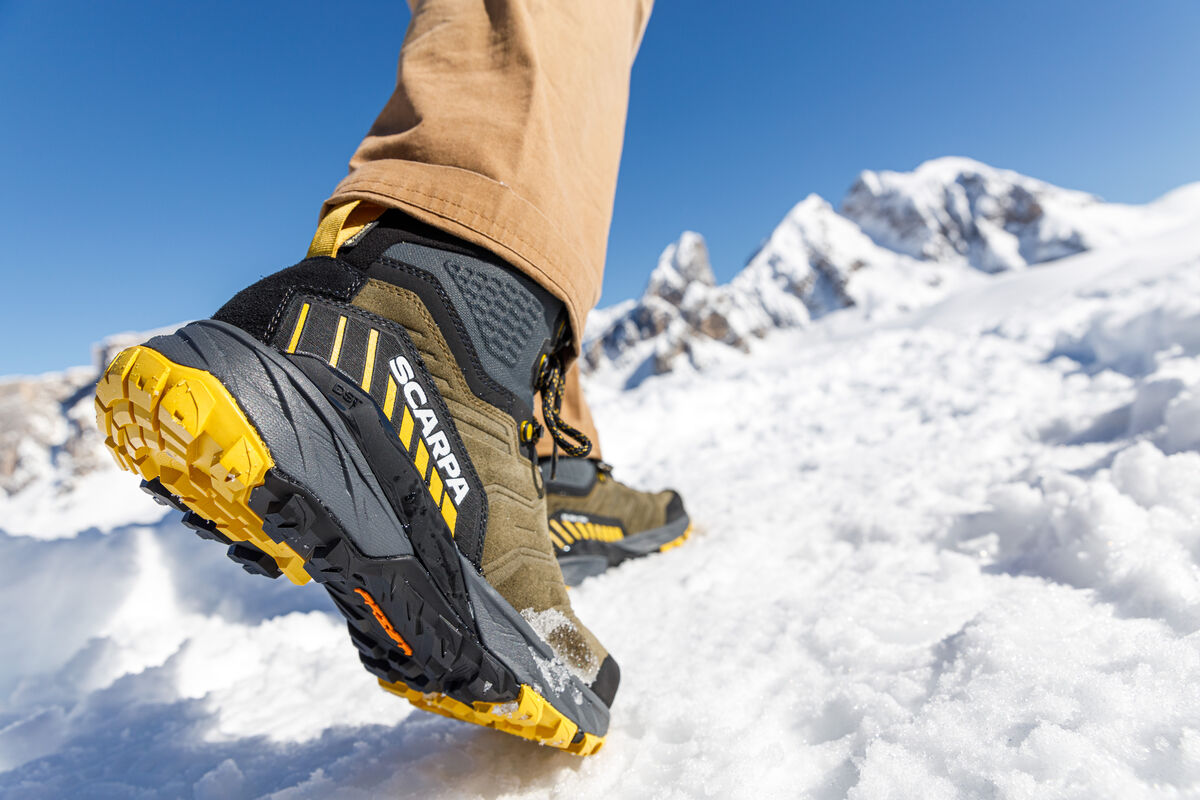
A waterproof membrane allows you to tackle even the most extreme conditions. Photos by SCARPA
Trekking shoe materials: from leather to synthetic
Once we have identified the type of boot or boot, we can turn our attention to the material from which they are made.
Leather: comfort above all
Leather is the first material to be used to produce trekking footwear. In addition to a softness that allows the details of each point of the upper to be defined, leather has long been appreciated for its ability to last a long time (assuming one takes care of its maintenance) and to give a feeling of comfort even during the most intense use. There is a wide choice of leather trekking shoes, especially in the area of winter trekking, where breathability takes second place to thermal insulation characteristics. Nothing prohibits the use of natural materials with membranes of another type, such as Gore-Tex, to add waterproofing and make the shoe more versatile and suitable for wetter conditions.
Synthetic materials: lightness and breathability
Synthetic trekking shoes, on the other hand, are lighter in terms of the overall weight of the shoe and are more breathable than leather. Synthetic materials are often used to meet the needs of those who engage in 'fast and light' activities.
Of course, there are endless variations as regards to the combinations of natural and synthetic materials such as suede and microfibre, or leather with stretch fabric inserts, but also mesh, net and membranes.
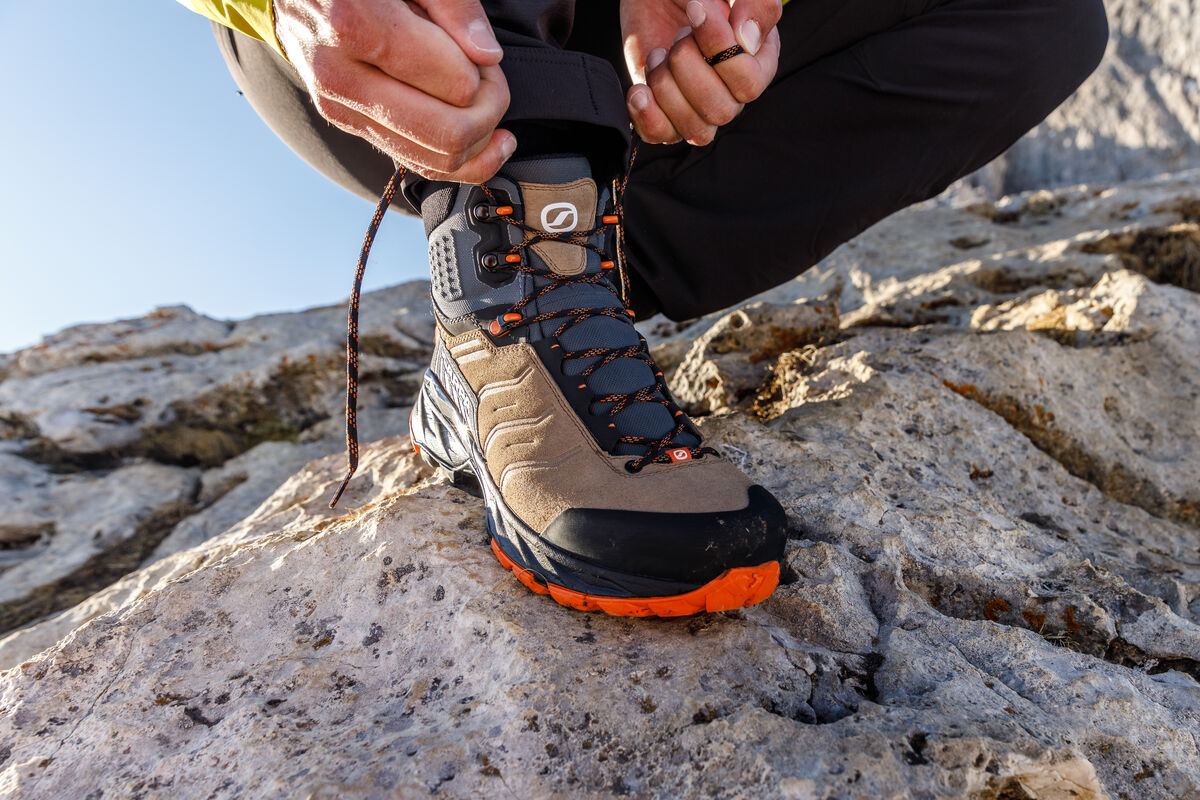
SCARPA Rush TRK GTX Military: support and solidity on the most technical terrain
Waterproof membranes: Gore-Tex and beyond
Almost all trekking shoes are complemented by waterproof membranes similar to Gore-Tex that guarantee water resistance and breathability. Whether for short hikes or multi-day treks, good waterproofing allows you to face even changing weather or terrain that is not perfectly dry with confidence. Gore-Tex is today the most popular name in waterproof membranes, but some brands implement other technologies at the same level and with even enhanced breathability properties.
The lacing system
It may seem like a detail, but choosing the type of lacing that ensures a stable and snug fit is a crucial aspect from the point of view of stability when walking. In addition to the classic lacing system of the ‘city-life’ shoe, we can also find - especially in the approach models - lacing that goes all the way to the toe, and which thus allows the precision of the lace-up system of climbing shoes to be applied to trekking shoes suitable for more technical terrain.
Apart from the laces, other aspects of the shoe contribute to the shoe feeling particularly snug around the foot, such as the tie systems. In some shoe models, for example, an all-around tie rod system has been introduced which wraps around the midsole at the front of the shoe and connects it directly to the lacing system, thus distributing the tension evenly throughout the shoe.
We can find this type of adjustable and precise lacing above all in the shoes of La Sportiva and SCARPA, which have always been particularly innovative in the solutions best suited to climbers and the use of these technologies on other product families.
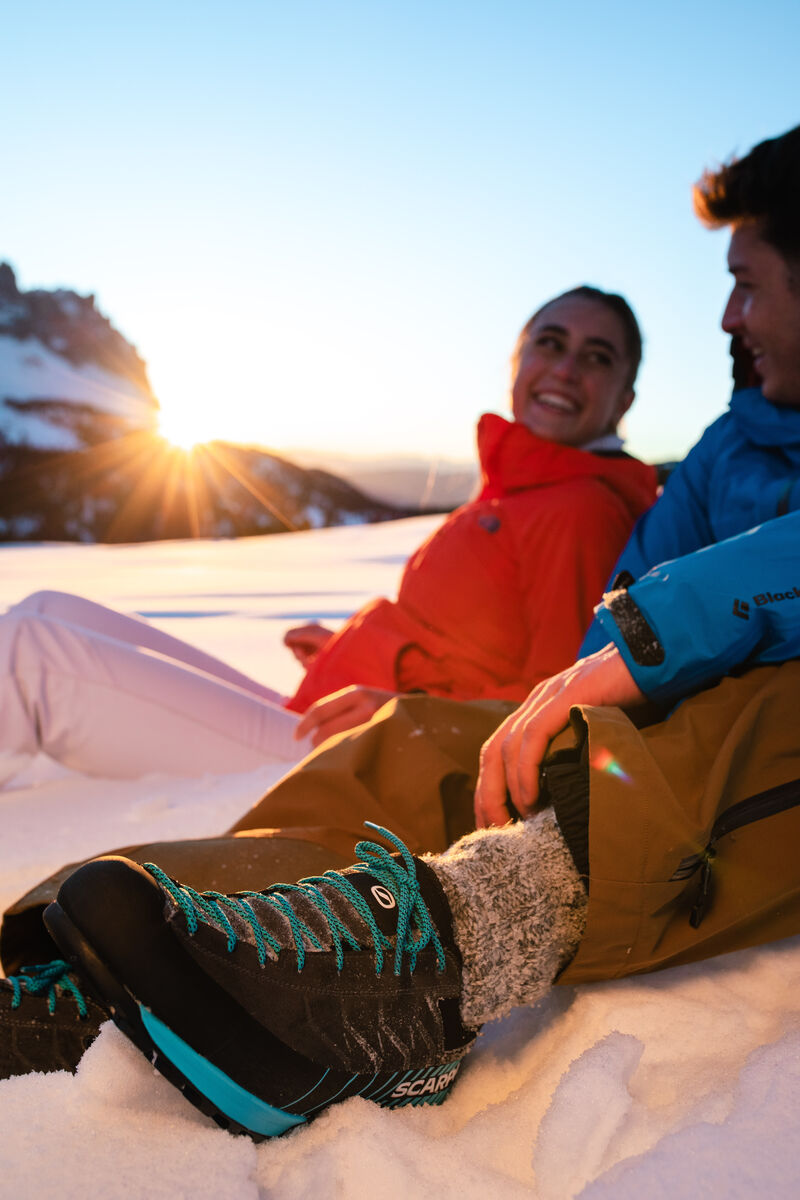
Walking on snowy terrain has never been so comfortable with the Mescalito GTX by SCARPA
Sole
The sole plays a fundamental role in terms of stability and cushioning on the roughest terrain. Depending on the use for which a trekking shoe is designed, the sole can be more flexible, thus giving greater freedom of movement to the foot and a lighter feeling in the fit, or more structured, to protect the hiker from shocks and stress on the most technical terrain. Vibram, an absolute reference in the world of soles, proposes many different types of compounds, such as Alpine Hiking, for performance and control on a wide range of mountain terrains (even wet or muddy), Drumlin, exceptional in terms of traction and grip, and XS Trek, suitable for low-profile shoes for lightly loaded hikes on any terrain.
Climbing Zone
Some trekking shoes, including approach shoes, offer a Climbing Zone in the front of the shoe, ideal for tackling the delicate climbing sections on the most technical routes. The Climbing Zone is sometimes also associated with a Braking Zone on the heel, to prevent the foot from slipping on the steepest climbs.
Crampons compatibility
Many models of ‘mid’ or high trekking shoes made for winter trekking can be compatible with classic crampons or semi-automatic crampons: this possibility should always be checked when choosing, naturally taking into account the type of equipment we already have.
Cover image: SCARPA Mojito Hike Paolo Sartori


