
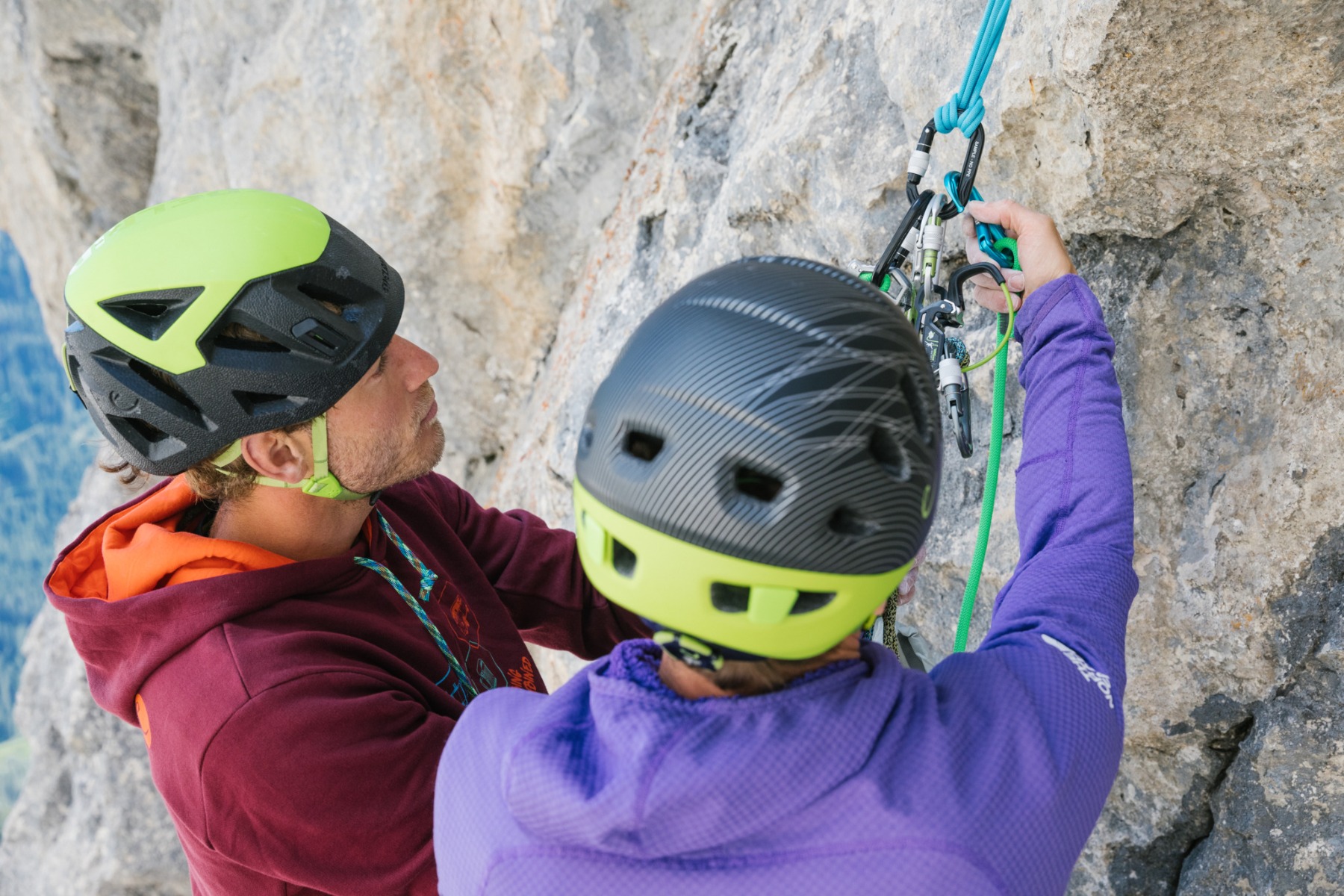
What equipment do you need to climb multi-pitch routes? We asked Fabio Meraldi, mountain guide and climber, what equipment he always carries with him when preparing for a multi-pitch climb.
Edelird Schreiber Poetter
Fabio, the choice of equipment is undoubtedly crucial. What do you put in your rucksack when you set off on a multi-pitch route?
First of all, a good multi-pitch backpack, at least 20 or 25 litres. Then you need to know everything about the route. The first place to look for answers is the route report. If we are talking about a multi-pitch sport route, we can safely assume that the route is well-equipped, both in terms of progression and belaying. In this case, we need the basic equipment: a single rope, climbing shoes, harness, helmet, and chalk. I would add a headlamp if we think there is a chance of being late, and a windbreaker just in case. Then I always carry a basic kit: finger tape and a knife for lanyards. It is good to have a charged mobile phone and, as we are out all day, enough food and drink.
What about the technical equipment?
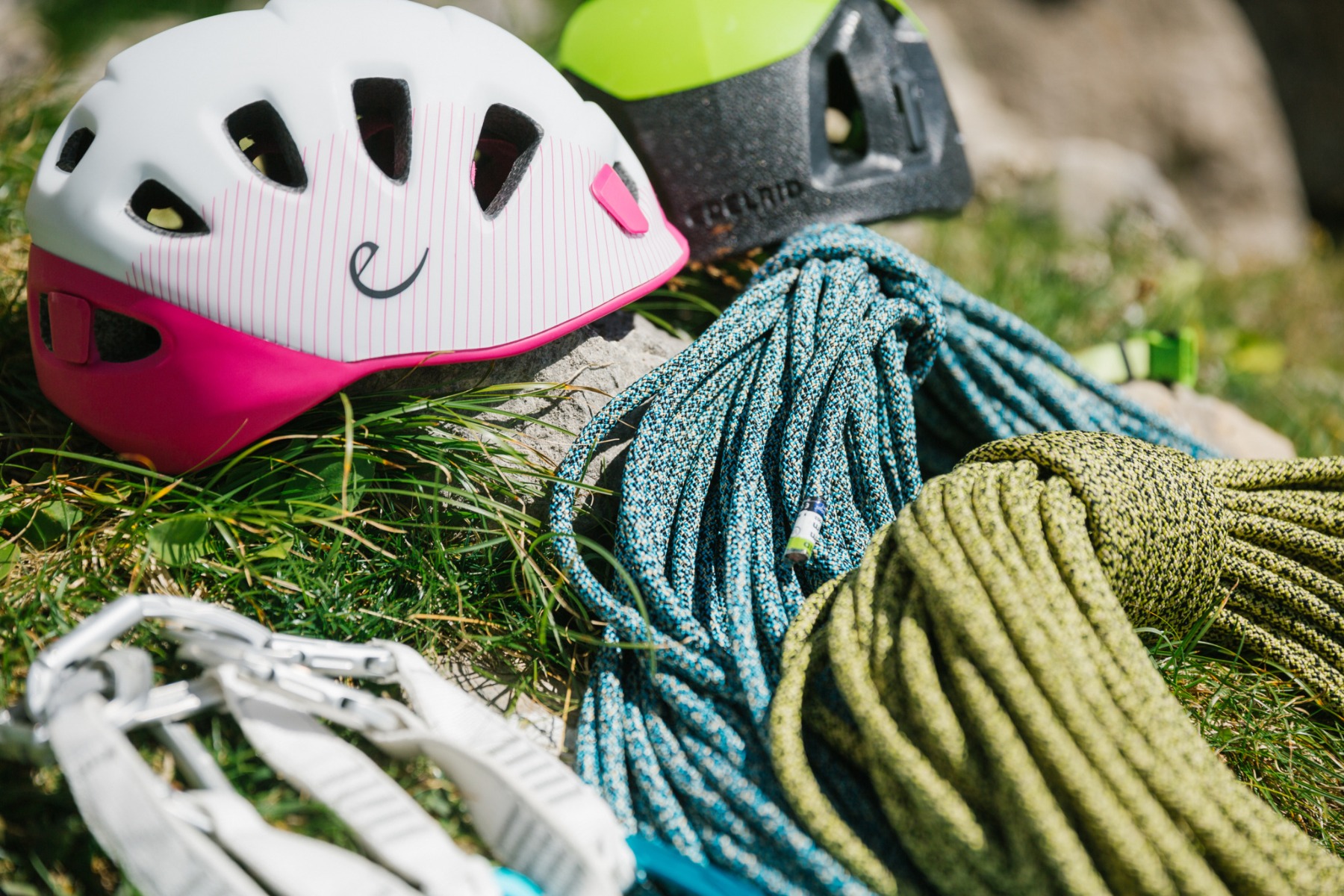
Reading the report again, we can count the number of quickdraws we need. It is a good idea to bring different lengths of them to cope with the different environments that the route offers. The same goes for the sling loops to extend the quickdraws, let's take at least six and of different lengths. Always carry a daisy chain in your rucksack. For safety's sake, let's also bring normal carabiners and screw-lock carabiners. Finally, in case you need to rappel, it is good to have two pieces of cord to organise a machard, as well as a belay plate and a pair of climbing descenders.
Do things change when we have to tackle a traditional route?
Certainly, the equipment listed above should be supplemented with other equipment. First of all, it is worth bringing a pair of half ropes or twin ropes. Then let's consider this: the protection on traditional routes is often inadequate and the belays are not necessarily well equipped. It is therefore necessary to equip yourself with suitable equipment to supplement both the protection in the ascent and the belaying. Here too, the report comes to the rescue: we are usually told the appropriate size of nuts or friends that it is recommended to carry. For extra safety, especially when belaying, we always carry a pair of pitons and, of course, the appropriate hammer.


