
Carabiners are an essential part of every mountaineer's equipment: their "basic" function is to connect the rope to any point of protection, whether it be a bolt of a sport climbing route, a friend of a trad route or a loop sling of an alpine climbing route.
The carabiner consists of two parts, a body and a lever, connected by a pin. Thanks to the mobility of the lever through the pin, you can open and close the carabiner, allowing you to use it in many different climbing situations.
Its most common use is in quickdraws, i.e. two carabiners connected by a sling, which we will use for our vertical ascent. Once closed, the carabiner can be considered a metal ring capable of withstanding the load engraved on its spine.
Today there are many combinations of shapes, materials, types of gates, and different technologies, that result in optimum performance on different playing fields. Let’s see the main features.
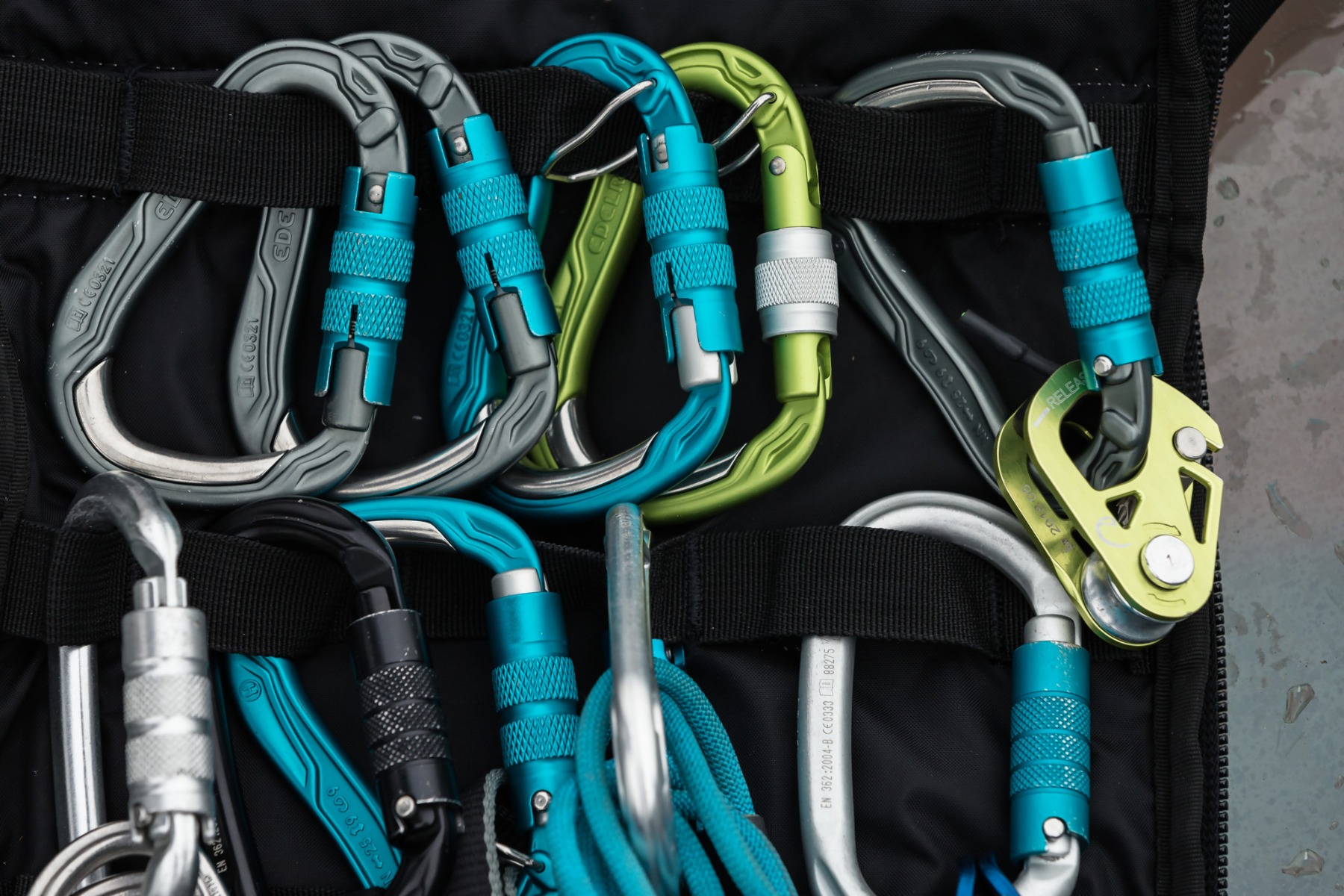
The shape
These are symmetrically shaped carabiners, generally used with gi-gi plates or similar descenders. Their shape, characterized by a straight rear arm, makes them comfortable and practical for belaying a second, but only if they are equipped with a screw-lock gate. They were the first type of carabiner to be produced and are ideal for attaching equipment or for artificial climbing.
D-shape carabiners are most commonly used for quickdraws; their shape makes it easier both to clip the quickdraw to the spit or bolt and to clip the rope. Especially when equipped with a screw-lock gate, D-shape carabiners can also be used with a Gi-Gi plate or to connect a daisy chain on alpine routes. D-shape carabiners can be either normal or asymmetrical, with a slight difference in the width of the lever opening, the internal space and the final weight of the product.
The pear-shaped carabiner was created with the precise aim of offering a carabiner with enough space for all internal rope maneuvers and for tying of the most important knots. Automatic locking carabiners are also suitable for connecting the harness to various types of belaying devices, for mountaineering and maneuvering on multi-pitch routes. Pear carabiners are mainly used for belaying and abseiling.
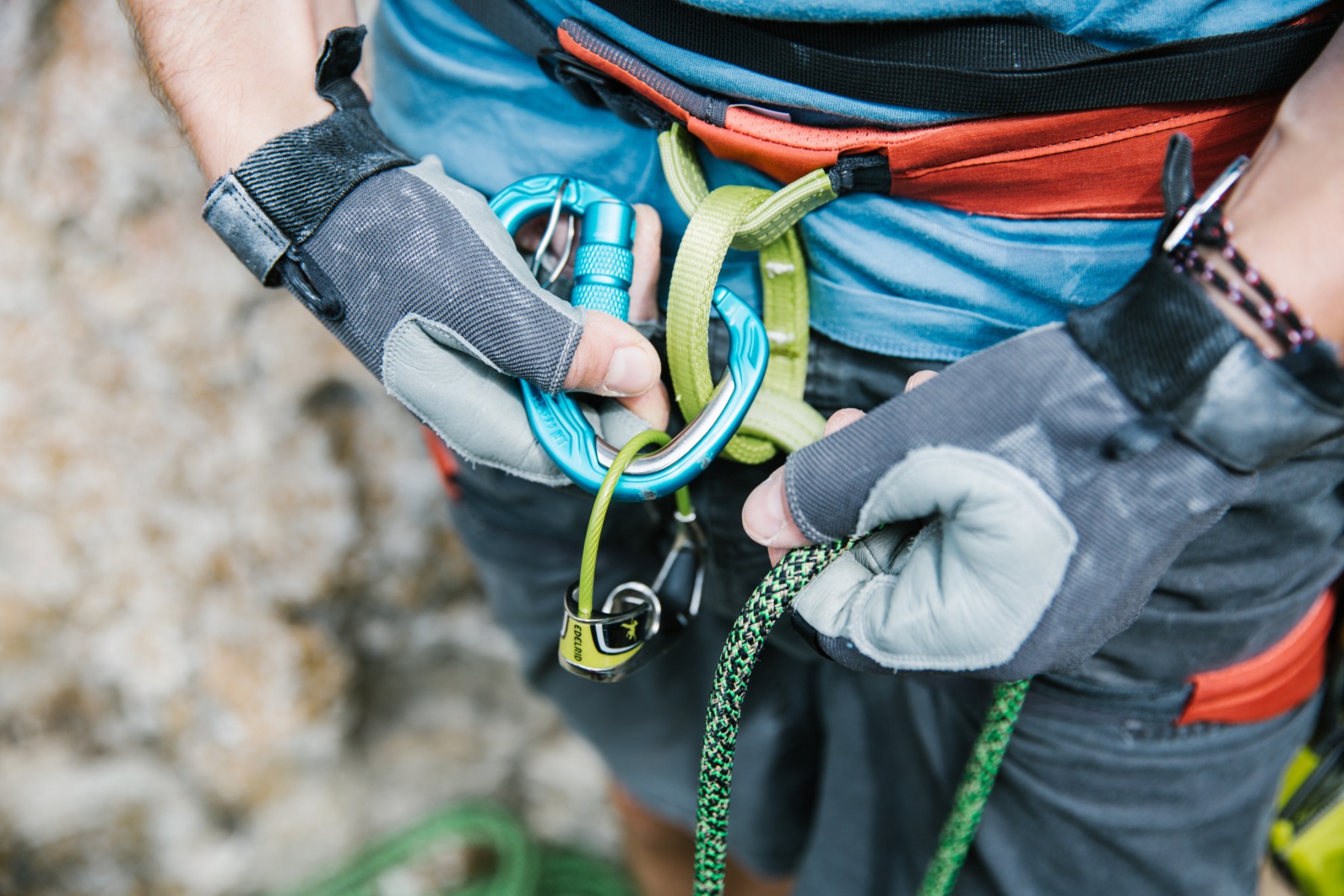
Materials
Steel
Stainless steel carabiners have a higher durability when climbing in very wet situations, or for example on sport climbs that are close to the sea. On the other hand, they are much heavier to carry, especially considering the consistency of our equipment.
Aluminium
Much lighter material than steel, it has excellent strength and resistance, but is more delicate to maneuver than a steel carabiner. Anyone who has already experienced the importance of saving grams on every piece of equipment knows how valuable it is to have light gear, especially in contexts related to mountaineering or multi-pitch routes.
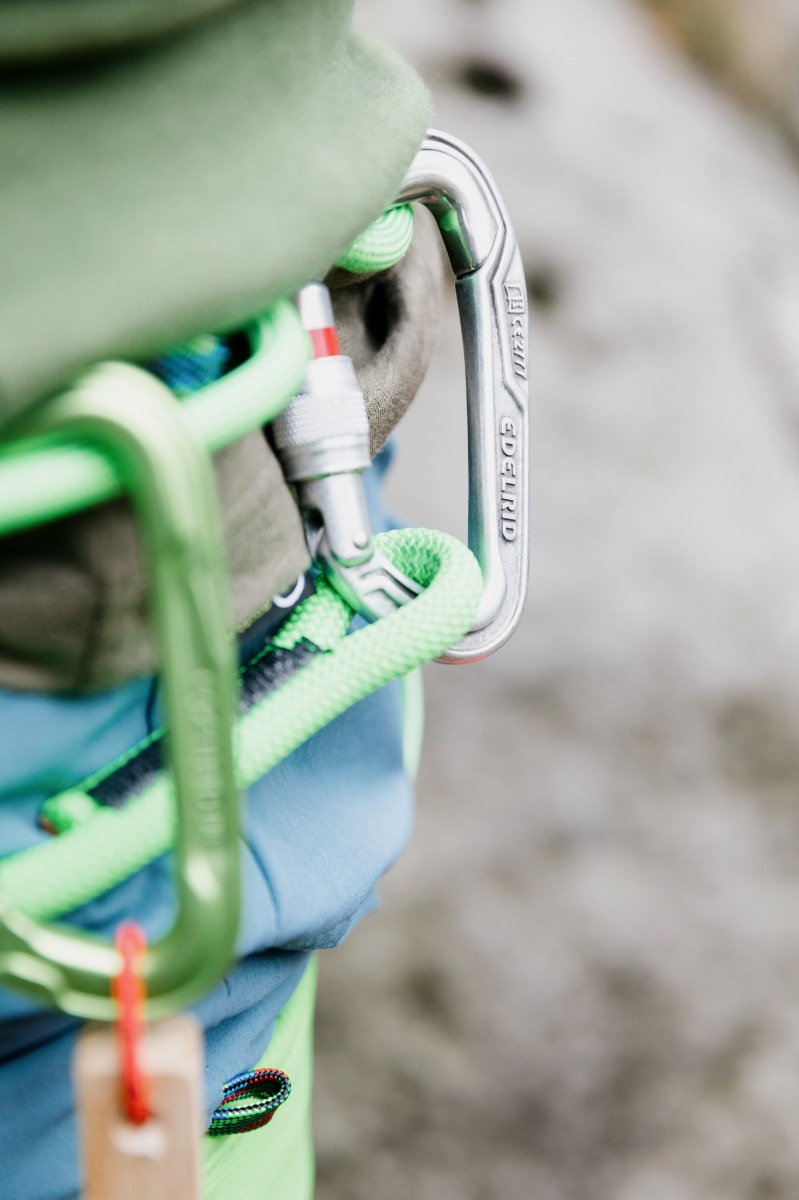
Carabiners gates
Gates can have different characteristics in their structure - which can be "full" or "wired", and in their shape, which can be straight or curved. Some of these parameters correspond to well-defined specifications: for example, when using a quickdraw with a straight and a bent gate, the first is always the one that must be connected to the bolt or spit, while the second corresponds to the carabiner to which the rope is clipped. Other aspects, such as the full or wire gate can be chosen according to the context in which we are climbing and our personal preferences.
Wire gate
Wire gate carabiners are generally used in quickdraws for two reasons: they make the quickdraw lighter, and they also offer less resistance both when we need to place the quickdraw on our route and when we need to clip the rope. The wire gate has a lower mass, which means there is less chance of the lever opening accidentally, but also less chance of it freezing with high temperatures: this is why, it is also used in winter mountaineering and ice climbing.
Full gate
The full lever has a greater mass, and therefore a greater resistance, and is the only option we can find on any carabiner that is not used in the construction of a quickdraw. The full gate can generally withstand higher loads, and would therefore be preferable in all those situations where you expect to "fall a lot". There are two types of gates: the straight gate and the bent gate. Straight gate carabiners are used in many different situations: for example, they can be found on quickdraws - both on the bolt and the rope side - or as connectors for friends and nuts, as well as attached to the harness to carry spare material. Curved lever carabiners are commonly used for rope-side replacements, as their curved shape makes clipping the rope easier and more fluid.
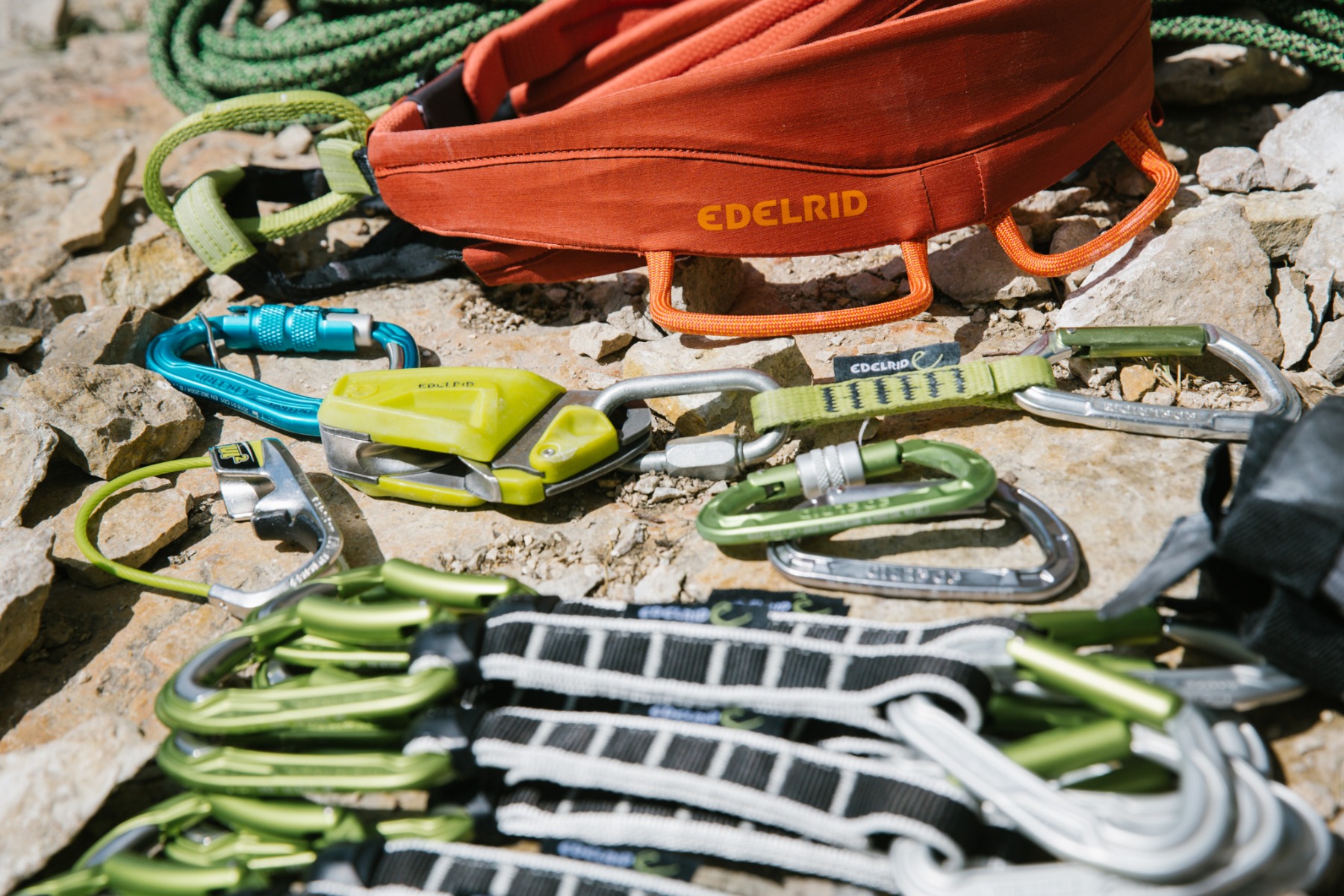
Locking systems
Keylock carabiners
The patented keylock closure, now ubiquitous on all the major quickdraws, can be combined with standard carabiners, as well as with the HMS screw-lock carabiners that we will see later. The keylock closure consists of a straight lever with a grooved grip area that makes perfectly fits into the corresponding opening of hte gate, thus preventing the rope getting entangled during clipping. In this case, both the nose of the lever and the arm are smooth and without edges, so that the rope is not exposed to cutting edges.
HMS carabiners with screwgate
HMS, that is pear-shaped carabiners, are specially designed to hold knots, to connect harnesses to belay devices, or to equip rappellers or anchors. The HMS carabiners with a screw-lock closing system are specifically designed to be used with the Munter Hitch knots, thanks to the wide and flat base, that allows the knot to slide without friction.
Automatic 3-movement carabiners
The Screwlock closing system is reinforced by a triple movement, without which the lever cannot open. These carabiners are generally used for belaying, anchoring, and rescue operations as they are made of very light alloys, ideal for mountaineering, multi-pitch, and sport climbing. In addition to the triple movement closure, there also are similar carabiners that have an automatic double movement closure, automatic ball lock, slider or twin-gate closure. All these types of closing systems represent safety locks used to prevent accidental opening of the lever, resisting even very strong pressures from the outside.
Carabiners certifications
CE or UIAA
All carabiners used for climbing or mountaineering activities must be CE or UIAA certified (or both). This certification, the numerical code of which is engraved on the carabiner, guarantees that the equipment complies with specific safety parameters. It is always useful to read the labels or reference manuals to understand the nature of these certifications or, for example, the loads that are indicated as the maximum weight that the carabiner can withstand.
CE certification is required to sell any type of product within the European Community; therefore, the parameters established by the EC are very similar to those evaluated by the UIAA.
The latter is an organization founded in 1932 with the specific purpose of establishing safety standards for mountain activities, and it is a federation that protects all those who live in the mountains on a 360-degree basis. The UIAA, formed by climbers and mountain experts, does not test products themselves but only the safety standards necessary for their use.
Climbing carabiners must therefore have one or both of the two certifications.
Other types of carabiners
There also are other types of carabiners such as anchor multipliers, carabiners for via-ferrata, and safety-work carabiners; take a look at our website to see all the available types and their main features.
All images by Edelrid Mediencenter


