The Orco Valley, located in the north-west of Turin between Piedmont and Aosta Valley, touches the municipalities of Noasca, Ceresole Reale, Locana, Pont Canavese, Ribordone and other smaller towns. Its location close to the Val D'Aosta, but also to the French border with Val Cenis, defines a first section of the Park of the Gran Paradiso, the oldest National Park in Italy.
We can therefore imagine how it is an area first of all rich in rock, but also in uncontaminated and wild natural environments, remote areas and routes that have made the history of climbing, espcially in Italy.
Orco Valley was symbolic of the "fracture" with the classical mountaineering in the 70’s and 80’s, offering to a new generation of climbers the ideal ground to experience new climbing ethics. From there it has experienced various phases with ups and down, establishing itself in recent years as a must-see destination for anyone who loves the style of crack, trad and long routes climbing on exceptional rock.
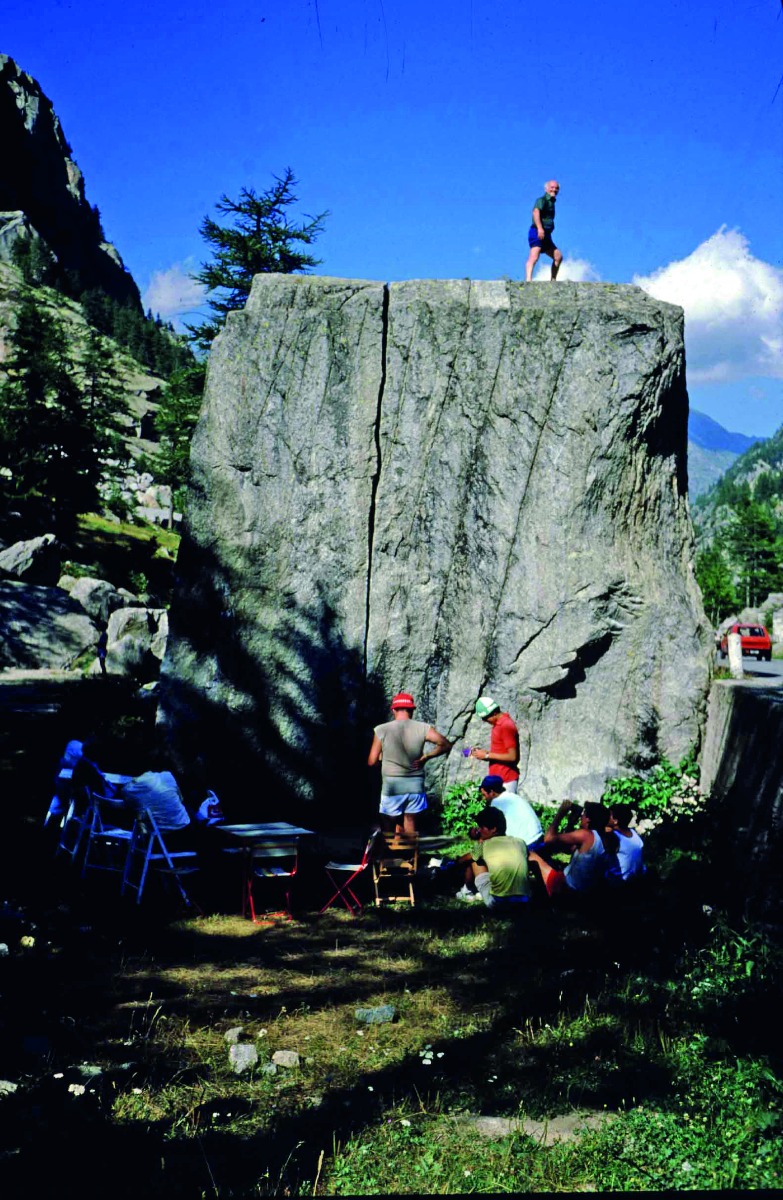
The Kosterlitz Crack in the 80s © Archive Andrea Giorda
Il Nuovo Mattino (The New Morning)
It was between these immense walls, split by perfect cracks, that the movement of Il Nuovo Mattino was born, where people like Gian Piero Motti, Ugo Manera and Guido Morello, to name just a few of them, gave the necessary boost to change the vision of climbing. Inspired by the American ventures on Yosemite, of which specialized magazines were narrating, Ugo Manera and Gian Piero Motti developed a "local" counterpart to the climbing routes of the Captain.
Thus the first ways on the Caporal were born, so named referring to El Capitan, that somehow represented an opening to a new climbing culture that was evolving, a climbing that was sufficient in itself and did not need other "higher" ends - like mountaineering - to exist. "Tempi Moderni" route is symbolic of the message that these climbers wanted to spread: the adventure, the one that requires all your most dedicated commitment, can also be found at heights "where the pines grow above", to quote Stefano Dalla Gasperina. To him and his brother Matteo we owe the creation of the new guide Valle dell'Orco published by Versante Sud where, in addition to detailed descriptions and reports on trad and multpitich routes, we can also find a lot of sport climbing sectors and interesting historical digressions.
Climbing in the Orco Valley
The Orco Valley immediately evokes the image of perfect cracks and long routes to climb in trad style, but many climbers come here to test themselves on the boulders that dot the lower valley and on the sport climbing crags. Here, in fact, even in the hottest months, where in Turin it is impossible to event think of grabbing a hold, you can always find some degrees less, a little breeze or some inviting boulder hidden among the vegetation of the valley.
The area that offers the widest choice of cliffs is that of Pont Canavese: here both on the right and left of Torrente Orco there are interesting walls that have been recently bolted to offer climbing possibilities for all levels, and that are added to the more historical Bosco and Franchiamo. The granite, not exceptional as that of the areas that already fall within the Gran Paradiso National Park, brings to a technical climbing, an excellent "school" for anyone who wants to improve himself in climbing technique. Other interesting cliffs are located in the area of Ceresole Reale and Valle Soana but, browsing the new guide to Versante Sud, you can find other small corners dedicated to sport climbing scattered in the different areas that make up the Orco Valley.
Pont Canavese - Frachiamo
As we said before, in the area of Pont Canavese there are several climbing possibilities for those who want to spend a weekend at the crag. Frachiamo is one of the most historic cliffs, which saw the first work of bolting in the 90s and that has continued to be always updated over the years. It has everything you can look for in a crag suitable "to a large audience": routes of different difficulties, almost zero approach and excellent rock. Its exposure is however completely south, which can be very discouraging in the summer. Sectors have well-defined ranges of difficulties, with some walls mainly intended for climbers who are making their first experiences on the rock and other areas dedicated to a medium/ high level.
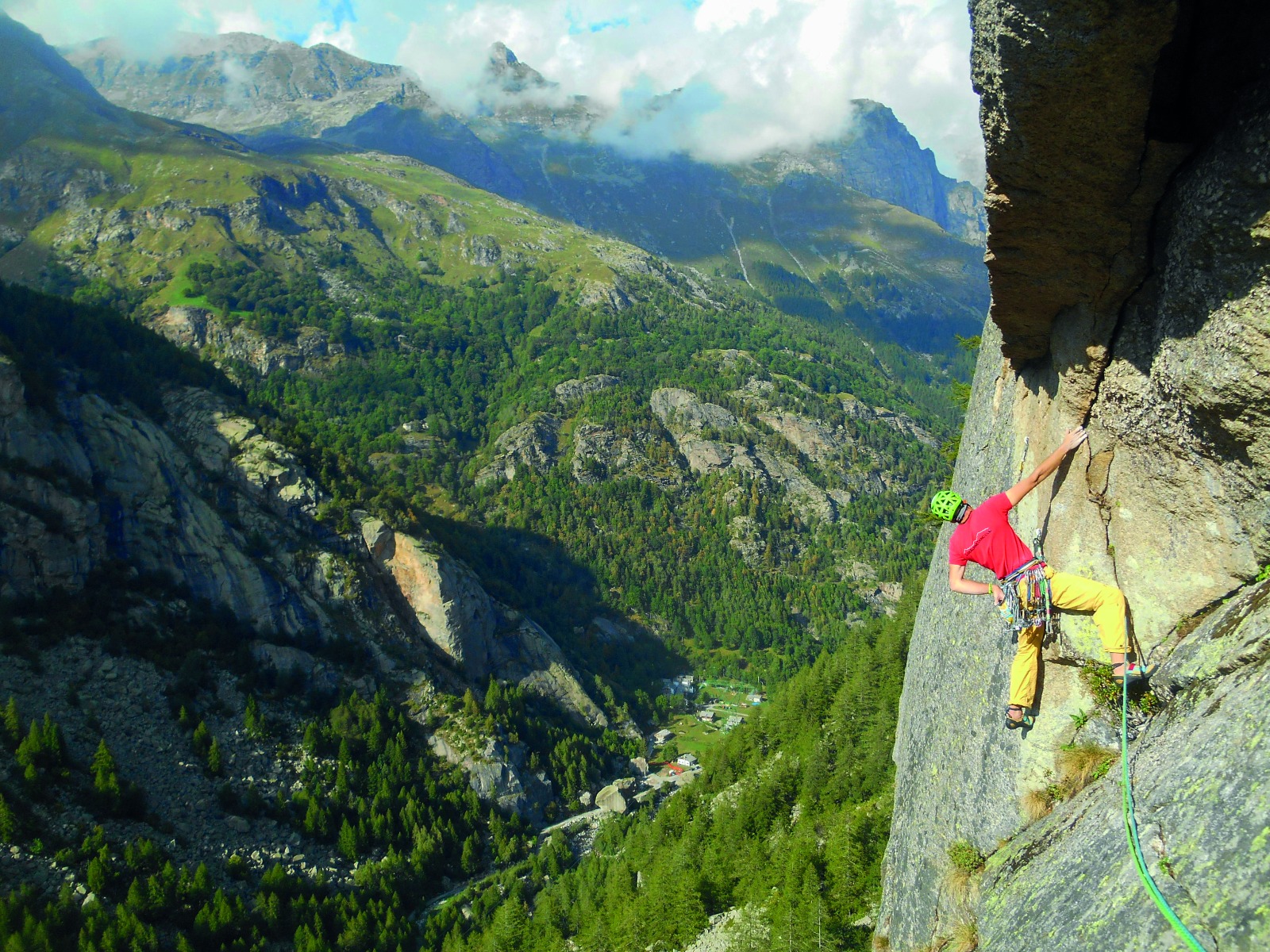
Umberto Bado - Per un pugno di sale © Alessandro Masiero
Bridge of Canavese - Bosco
Same orientation also for Bosco, one of the most historic pine-lined cliffs in Turin and all over Piedmont. In this crag we find a rock with more characteristic that makes it first of all an area "sui generis", different from the many other neighboring cliffs, and that has at the same time the advantage of not being aggressive on the skin. This style of climbing can be more difficult for those who are not accustomed to "open-hand" holds but, if you practice it, it can prove to be a very useful training and a climbing style of great satisfaction. Here is always active an important work of bolting that now concerns especially in the most overhanging sector; it is always growing, offering increasingly high difficulties and, not to be underestimated, giving a real opportunity to climb even on rainy days. A very short approach and an excellent bolting complete the picture of a very popular crag.
Ceresole Reale
We move to the area of Ceresole Reale, particularly rich sport climbing crags with routes for every difficulty, often enriched by a pleasant view of the lake of Ceresole or the imposing wall of the Sergent. The Valle dell'Orco guide of Versante Sud, written by Matteo and Stefano Dalla Gasperina presents most of these cliffs, alternating them with bigger walls equipped for long routes. In some of these cliffs we can find a combination between sport and trad climbing, an excellent option to start "catch an eye" to climbing trad style. We have chosen two, with great difficulty given the very wide and interesting proposal, although we recommend you to take a look at all those smaller areas that can give you a day of absolute relaxation and with equally enchanting views.
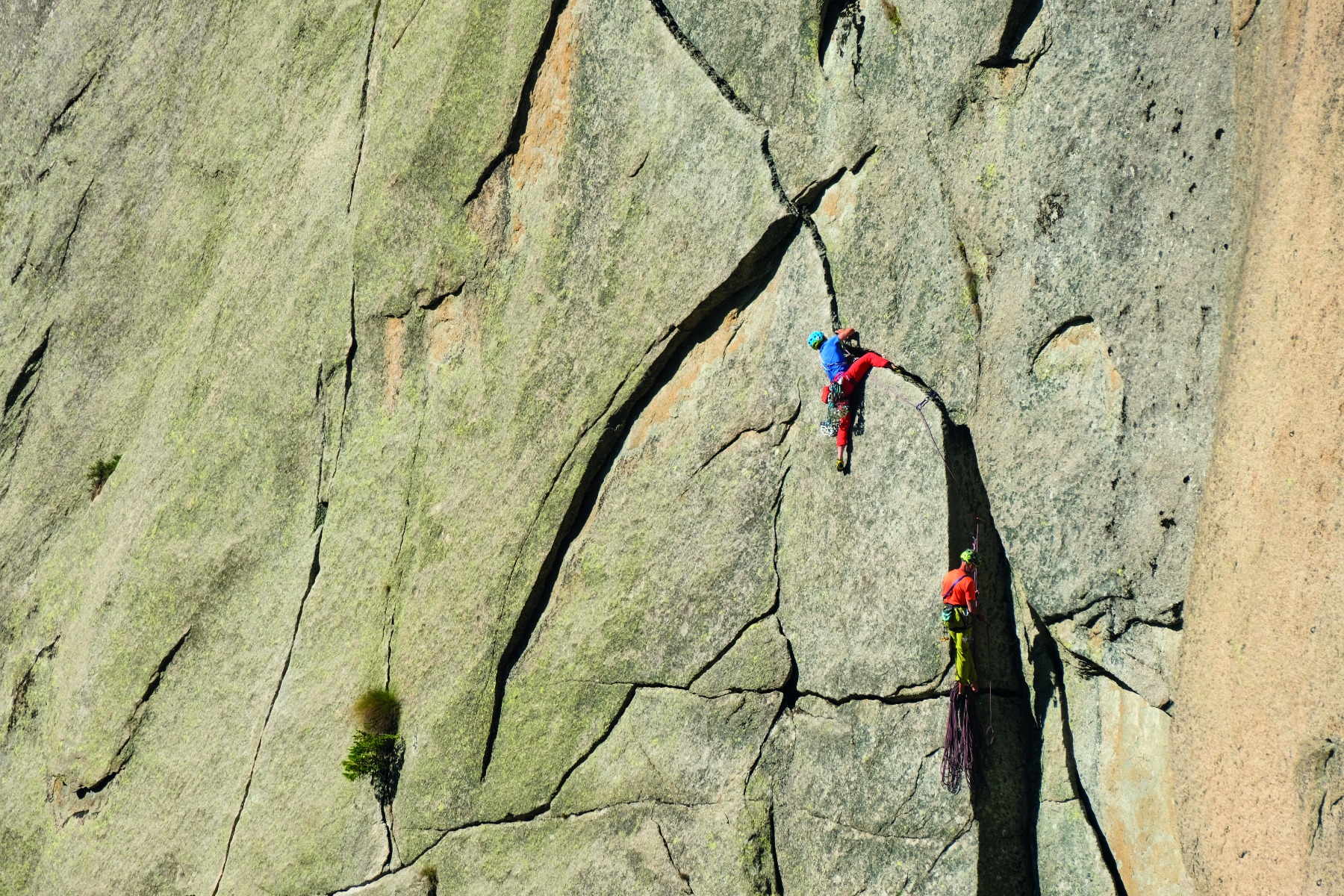
Ivan Cesarin e Rinaldo Sartore - Fessura della Disperazione © Alessandro Masiero
Ceresole Reale – Il Droide
Here is a first example of a beautiful cliff of single pitch and crack climbing placed at 1600 meters high, and one of the first cliffs in Valle dell'Orco to have received attention in terms of modern bolting. The granite structure offers climbing routes on smooth and delicate slabs or cracks to be climbed in trad style; in both cases the routes always end with reliable belay stations. Climbing can be more technical on the vertical sections, more physical on the most overhanging sides of the crag: you can choose from a total of about thirty lines with difficulties from 5b to 8b+, although it is strongly recommended to have an intermediate level and a good experience on the rock to enjoy your climbng day.
Ceresole Reale – Il Dado
Another historic cliff that is easily located above Ceresole Reale, where there is no lack of historical and emblematic climbing routes in Valle Dell'Orco, as can be Legittima Visione, The Escargot, and White Wall. Also in this case sports climbing and crack climbing routes are mixed up with an always demanding style, difficult to be read and requiring to master climbing techniques such as dulfer, chimneys and opposition climbing. The rightmost section offers sports-oriented routes with lengths up to 35 metres and difficulties that reach 8b+: this is also one of the reasons that brought here top climbers over the decades, and that matched their name to many top-level First Ascents. From the most historical routes signed by Vincenzo Sartori, Guido Zanet, Giovanni Crotti and Giovannino Massari, to the masterpiece Legittima Visione by Adriano Trombetta then extended by Sean Villanueva with a second length of 8b, here each route deserves a small historical digression.
Soana Valley - Forzo Valley
Compared to the other areas presented so far, the Forzo Valley represents a more recent reality, but not for this less appreciated by climbers living in Piedmont. Here too we have walls mostly equipped with long routes, all framed by a suggestive environment, But in the last few years a beautiful cliff has also been bolted to complete the vertical picture of the valley. Small Rainbow was born in 2022 and has a south-west exposure, combined with an altitude of 1000 meters high, which makes it frequentabile all year round. The approach already slightly above average, we are talking about a walk of forty minutes, maybe keeps away the large crowds, factor that makes the crag particularly quiet. The difficulty of the routes varies from 5c to 7c, with crimps and holes that require excellent technique and a good rock climbing experience.
Discover all the new sport climbing crags in Orco Valley: come and have a look at the new guidebook by Versante Sud!